AI Water Monitoring Platforms: How AI Improves Smart Water Management
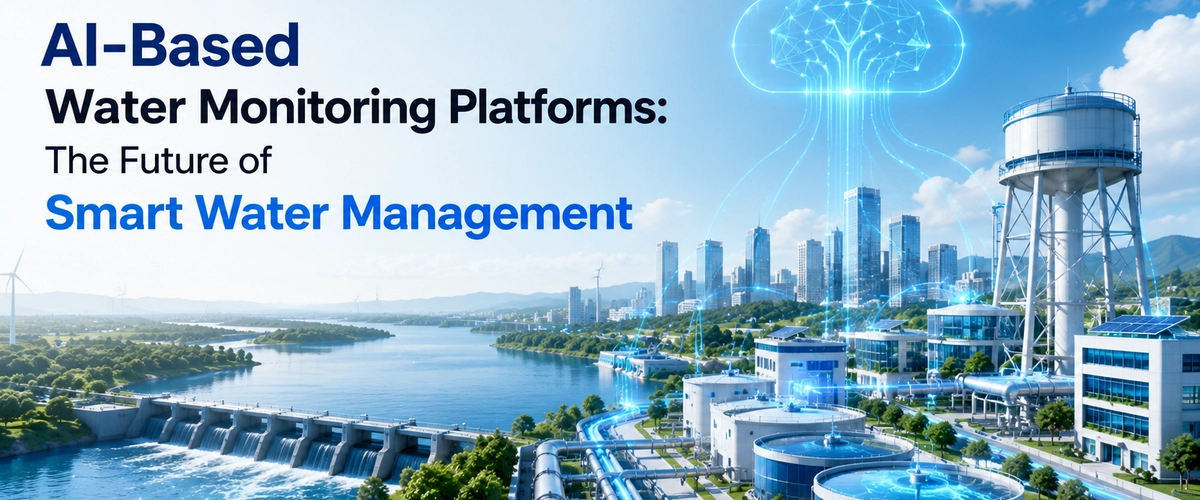
AI Based Water Resource Management Platform
Water management is moving beyond simply checking tank levels and recording water consumption. Commercial buildings, industries, hospitals, campuses and municipalities increasingly need continuous visibility into how water is stored, consumed, transferred and managed.
An AI water monitoring platform combines IoT sensors, connected devices, cloud-based data and artificial intelligence to turn real-time water data into useful insights. Instead of only showing the current tank level or flow rate, an intelligent platform can identify unusual patterns, support faster decisions and help automate parts of the water-management process.
A typical system can collect data from water tanks, flow meters, pumps, pressure points and water-quality sensors. This information can then be analyzed to understand consumption patterns, identify abnormal conditions and improve operational efficiency.
The goal is simple:
Monitor water → understand the data → detect problems → automate where appropriate → improve water management.
This article explains how AI-based water monitoring platforms work, what data they use, where they can be applied and how they support smarter water management.
What Is an AI Water Monitoring Platform?
An AI water monitoring platform is a digital system that combines water-monitoring sensors, IoT connectivity, cloud software and AI-based data analysis.
The sensors collect information from physical water infrastructure, while the software organizes and analyzes that information.
Depending on the application, the system can monitor:
- Water tank levels
- Water flow
- Pump status
- Pump runtime
- Pressure
- Water consumption
- Water quality
- Valve status
- Device health
- Historical usage patterns
The AI or analytics layer can then help identify unusual behavior, recurring patterns and conditions that require attention.
For example, if a building normally consumes a similar amount of water every day but suddenly shows unusually high consumption overnight, the system can flag the abnormal pattern for investigation.
This is different from a basic monitoring system that only displays the current value.
AI Monitoring vs Traditional Monitoring
Traditional monitoring:
Sensor → Data → Dashboard
Intelligent monitoring:
Sensor → Data → Analytics → Pattern detection → Alert/Recommendation → Action
The value of AI therefore comes not from the sensor alone, but from what the platform can do with the data collected from the water infrastructure.
How AI and IoT Work Together for Water Monitoring
An IoT water monitoring system collects data from connected field devices and sends it to a centralized monitoring platform. AI can then analyze this data to identify patterns, exceptions, and changes that may require attention.
A typical AI and IoT water monitoring architecture includes:
- Level sensors to monitor water stored in OHTs, sumps, reservoirs, and other tanks
- Flow meters to measure water movement and consumption
- Pump controllers to monitor and automate pump operation
- Pressure sensors to understand operating conditions in water systems
- Water quality sensors to monitor parameters such as TDS, pH, turbidity, conductivity, and temperature where required
- Wireless connectivity such as LoRaWAN, 4G, Wi-Fi, or NB-IoT for transmitting field data
- Cloud-based monitoring for centralized access to data and alerts
- AI and analytics for identifying abnormal patterns and supporting operational decisions
The result is more than simple sensor monitoring. Organizations can move from collecting water data to understanding how their water infrastructure is performing.
What Can an AI Water Monitoring System Monitor?
A modern water monitoring system can combine data from multiple connected assets instead of monitoring only the level of a single tank.
Water Tank Levels
Wireless radar level sensors continuously monitor water levels in overhead tanks, sumps, reservoirs, and industrial storage tanks.
Water Consumption
Flow meters can provide data on water usage, helping identify consumption trends, peak demand periods, and unusual changes.
Pump Operation
Smart pump controllers can monitor pump status and automate operation based on configured level, pressure, or timing conditions.
Water Distribution
Flow and pressure data can help operators understand how water is moving through different sections of a facility or distribution network.
Water Quality
Connected water-quality sensors can monitor parameters such as TDS, pH, turbidity, conductivity, and temperature depending on the application.
Alerts and Abnormal Conditions
The monitoring platform can generate alerts for conditions such as low tank levels, high levels, abnormal consumption, pump events, or other configured operating conditions.
By combining these data sources, organizations can build a more complete view of their water infrastructure rather than relying on isolated measurements.
How AI Powers an IoT-Based Water Monitoring Platform
At My Tank, AI is integrated into our smart water management ecosystem to deliver real-time visibility, predictive insights, and intelligent automation.
Our AI engine continuously analyzes data received from connected IoT devices such as:
- UltraLevel Max – Solar-powered wireless radar water level sensor
- UltraLevel Pro 2.0 – High-precision radar level sensor
- Smart Single-Phase Pump Controller
- Smart Three-Phase Pump Controller
- Water Flow Meter
- Wireless Valve
- Water Quality Monitoring Sensor
My Tank brings these layers together in a connected water management platform. Field devices collect information from tanks, pumps, pipelines, flow points, and water-quality monitoring points. Depending on the deployment, data can be transmitted through technologies such as LoRaWAN, 4G, Wi-Fi, or other supported connectivity options.
The My Tank platform then brings the collected information into a centralized dashboard where users can view current conditions, historical data, alerts, and equipment status.
AI and analytics can be applied to this data to identify unusual consumption patterns, recognize changes in operating behaviour, support predictive alerts, and provide actionable information for water-management teams.
This architecture allows organizations to move from individual sensor readings to a connected water monitoring system that can support monitoring, analysis, and automation.
Smart Water Metering Systems for Better Decision Making
Accurate measurement is the foundation of every successful smart water metering system.
By combining intelligent flow meters with AI analytics, organizations gain complete visibility into:
- Water consumption trends
- Peak demand periods
- Daily and monthly usage
- Distribution efficiency
- Water loss analysis
- Performance benchmarking
These insights enable organizations to make data-driven decisions that improve both operational performance and sustainability.
AI and Remote Water Monitoring
Remote water monitoring allows organizations to view water infrastructure without relying on frequent physical inspections. Wireless sensors installed at tanks and other monitoring points can transmit data to a centralized platform, allowing users to view current conditions remotely.
When AI and analytics are added to remote monitoring, the system can go beyond displaying sensor values. Historical data can be analyzed to identify unusual water consumption, repeated pump events, unexpected level changes, or other patterns that may require investigation.
This is particularly useful for organizations managing distributed assets such as apartment buildings, commercial properties, industrial facilities, campuses, and municipal water infrastructure.
For a detailed guide to remote tank monitoring and mobile-based water level monitoring, see our remote water tank monitoring guide.
Supporting Sustainable Water Resources
Growing urbanization and climate change make water conservation more important than ever. AI-driven monitoring enables organizations to use water more responsibly by identifying waste before it becomes costly.
My Tank helps organizations contribute to sustainable water resources by:
- Reducing unnecessary pumping
- Eliminating manual inspections
- Improving water distribution efficiency
- Preventing overflow and leakage
- Supporting rainwater harvesting projects
- Optimizing groundwater utilization
- Enabling continuous remote monitoring
The result is a more resilient and environmentally responsible water management system.
Cloud-Based Tank Monitoring: From Data to Visibility
Cloud-based tank monitoring allows water-level and equipment data to be accessed through a centralized platform rather than relying on local inspection.
Connected level sensors can transmit tank data to the cloud, where users can view current levels, historical trends, alerts, and equipment status. When multiple tanks are distributed across different locations, a cloud platform provides a common view of the connected assets.
For larger deployments, this approach can support multi-tank monitoring, remote operations, data analysis, and centralized water-management decisions.
AI and analytics can further process the collected data to identify abnormal trends and provide more useful operational insights.
Smart Water Technology Solutions for Every Industry
Modern smart water technology solutions are no longer limited to utilities. AI-powered monitoring is widely adopted across:
- Industrial manufacturing
- Commercial buildings
- Residential apartments
- Hospitals
- Educational campuses
- Hotels
- Municipal water supply
- Agriculture and irrigation
- Rainwater harvesting systems
- Fire water storage tanks
Whether managing a single storage tank or thousands of distributed assets, AI ensures consistent performance and better resource utilization.
The Future of AI-Based Water Monitoring
AI is most useful when it is connected to reliable field data. By combining IoT sensors, wireless connectivity, cloud-based monitoring, analytics, and automation, organizations can build a more connected approach to water management.
An AI-based water monitoring system can help teams monitor tank levels, water consumption, pumps, flow, and other operating conditions from a centralized platform. Historical and real-time data can then support faster responses, better operational decisions, and more efficient use of water resources.
My Tank brings these capabilities together through wireless water monitoring, smart sensors, pump automation, flow monitoring, water-quality monitoring, remote visibility, and data analytics.
For organizations managing apartments, commercial buildings, industries, institutions, or distributed water infrastructure, the objective is not simply to collect more data. It is to turn water data into useful information that supports better monitoring, automation, and resource management.
Frequently Asked Questions
How does AI help with water management?
AI can analyze real-time and historical water data to identify unusual consumption patterns, abnormal operating conditions and changes in normal water usage. These insights can help teams respond faster and improve water-management decisions.
How does AI help in water management?
AI analyzes real-time and historical water data to identify abnormal usage, detect leaks, optimize pump operations, and reduce water wastage. This enables organizations to improve water efficiency while lowering operating costs.
Can AI detect abnormal water consumption?
AI and analytics can analyze historical and real-time consumption data to identify unusual patterns or deviations from expected behaviour. These insights can help teams investigate potential leaks, operational issues or changes in demand
What sensors are used in AI water monitoring systems?
Depending on the application, systems may use radar level sensors, flow meters, pressure sensors, pump controllers, water-quality sensors and valve controllers.
What is the difference between AI and IoT in water management?
IoT connects sensors and collects data from physical water infrastructure. AI analyzes that data to identify patterns, anomalies and insights. Together they can support intelligent monitoring and automation.